Grangex is working to restart iron ore mining at the Sydvaranger mine in Sør-Varanger municipality in northern Norway. As part of the preparations for restarting the Sydvaranger mine, Grangex and Sydvaranger have carried out an Environmental and Social Impact Assessment (ESIA), which in Swedish would be translated as a miljökonsekvensbeskrivning (environmental impact assessment).
Despite the mine’s long history, the many studies that have been carried out, and the fact that all permits for operation are in place, a comprehensive impact assessment has not previously been conducted. The ESIA consolidates and evaluates the results of historical investigations in combination with recently completed studies and analyses in relation to the planned operations. The impact assessment provides a foundation for the long-term sustainability work of the operation.
The ESIA has been prepared by independent external experts under the leadership of SLR and follows Norwegian and European standards. The study covers impacts from the entire operation – from mining and mineral processing to iron ore concentrate at the processing plant, as well as the handling of residual materials in the form of waste rock and tailings. Assessments have been made of the project’s impacts on both environmental and social factors.
The purpose of the work is to establish a baseline description and to ensure responsible management of impacts through measures in both the short and long term.
The full ESIA is summarised in a Non-Technical Summary here.
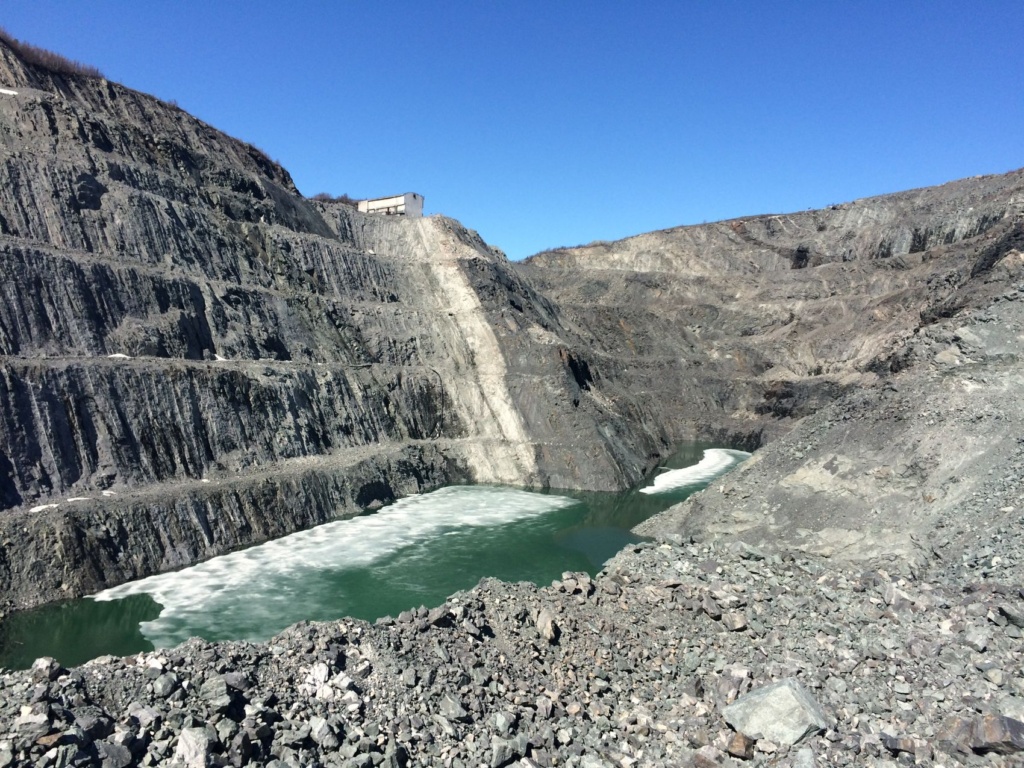
Method and background
The ESIA is based on studies conducted before Grangex acquired the Sydvaranger mine. On the basis of these studies, a gap analysis was carried out to identify which additional studies were required to create a clear and comprehensive baseline. Based on the gap analysis, a number of supplementary studies were conducted – including a water monitoring programme in and around the mine, a monitoring programme for Bøkfjorden, modelling related to surface water and groundwater, noise calculations, risk analyses related to vibrations, flyrock and air blast, an assessment of impacts on reindeer husbandry, waste characterisation of waste rock and tailings, as well as biological field studies on land and in water.
These studies formed the basis for the impact assessments across all areas where the project was assessed as having potential impacts.
The ESIA consists of the following parts:
- Project overview and methodology: Background, regulatory framework, stakeholder engagement and analysis of alternative solutions.
- Environmental and social impacts: Analyses of impacts within environmental and social areas, including mitigation measures, follow-up and monitoring.
- Cumulative effects: Assessment of impacts in relation to other planned projects in the area.
- Summary and conclusions: Overall results, recommended measures and references.
Project overview
Location and surroundings
Sør-Varanger municipality is located approximately 400 km north of the Arctic Circle and has a sub-Arctic climate with low, undulating terrain.
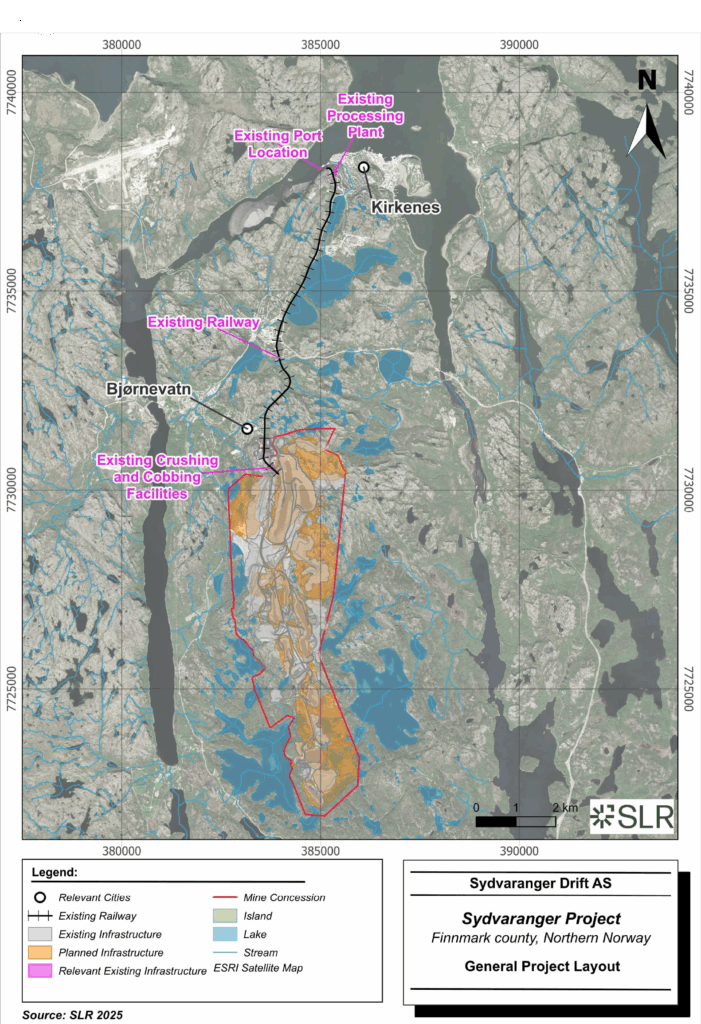
The map shows the overall project layout with existing infrastructure.
The mine is located at Bjørnevatn, approximately 7 km south of Kirkenes, where the processing plant is located and connected to the mine by an 8 km-long railway. The mining area spans two natural drainage catchments. Water flows partly eastwards towards Langfjorden and the Pasvik River, which forms the border with Russia, and partly westwards towards Langfjorden. Both watercourses discharge into Bøkfjorden outside Kirkenes.
The area around the mine, outside the concession area itself, is currently mainly used for outdoor recreation and tourism. Reindeer herding is also carried out in the area.
Geographical conditions
- Location: Sør-Varanger municipality
- Climate: Sub-Arctic, with an average annual temperature of approximately 1.1°C
- Topography: Low and undulating terrain, up to approximately 200 metres above sea level
- Land use around the mine area: Outdoor recreation, tourism, reindeer herding and holiday housing
Importance for the region
Historically, the Sydvaranger mine has been a central part of the economy of Sør-Varanger and an important employer in the municipality. Since mining operations were discontinued after the most recent operating period, the local economy has diversified, meaning that trade, tourism, the public sector and other community services now play a greater role in employment within the municipality.
The restart of the Sydvaranger mine will make an important contribution to recreating jobs, strengthening local supply chains and thereby supporting long-term local and regional development.
Main applicable permits
The project is covered by an established system of permits and rights.
- Operating concession: Regulates mining operations
- Environmental permit: Regulates, among other things, conditions for emissions to air, water and land
- Water permit: Regulates abstraction of raw water for the processing operation
- Railway permit: Authorises railway operations
Project design and planned operations
Mining operations at Sydvaranger are planned as conventional open-pit iron ore mining. Primary crushing and pre-concentration (magnetic separation) will also take place at the mine site. At the processing plant, the ore is finely crushed before the subsequent stages of grinding, magnetic separation and filtration to produce the final concentrate. The existing mine and processing plant will be used, and only minor upgrades are required to restart operations. All upgrades will use proven equipment. Process water will be sourced from nearby lakes. Water will be recirculated to a high degree during operations. Only the losses that occur when water follows the final product and tailings will be replaced with new raw water.
Production and logistics in brief
- Mining of up to 8 million tonnes of iron ore per year
- Production of up to 3.5 million tonnes of iron ore concentrate per year
- Deposition of up to 35 million tonnes of waste rock per year
- Permitted deposition of tailings of up to 4 million tonnes per year
- Ore transport via the existing railway to Kirkenes
- Shipment of produced iron ore concentrate from the existing port in Kirkenes
The ESIA covers the following areas:
- Terrestrial and aquatic biodiversity
- Soil and geology
- Surface water and groundwater
- Climate and energy
- Air quality, noise and vibrations
- Waste
- Social and community aspects
- Indigenous peoples and reindeer husbandry
- Archaeology and cultural heritage
- Landscape and visual impacts
- Cumulative effects
Key findings in brief
In addition to establishing a clear baseline, the ESIA shows that the Sydvaranger mine can be restarted in an environmentally and socially responsible manner, provided that the identified mitigation and monitoring measures are implemented as planned. The report identifies no unacceptable environmental or social risks and confirms that impacts can be managed through the proposed measures. The ESIA therefore provides a robust decision-making basis for continued project development and operations, while strengthening the conditions for long-term coexistence with local communities, the natural environment and other activities in the region.